

Travel trailers: all the benefits of a home-on-the-go WITH the ability to still leave the blasted thing behind! There are many good reasons travel trailers have remained the dominant category of RV in North America for so long.
But with demand comes supply. Right now, there are positively oodles of high-quality travel trailers bouncing around the market, from new to traditional to premium to downright iconic! So let’s start at the top—
With the best travel trailer brands!
Before you even start shopping models, it helps to know what the market’s top manufacturers of travel trailers and towable campers are offering. Every trailer brand has a little something different for every type of RVer…
Luckily for you, I’ve trimmed it down to just seven! This guide will review the 7 best brands of travel trailers, plus outline a few community-beloved models along the way. Moreover, we’ll be discussing the criteria of finding your perfect tow companion, including towing capacity and what defines a capable tow vehicle.
All together, that ought to give you the roadmap you need for a successful trailer camping season. After that, all that remains is to get out there and start hitching like a pro!
How We Chose the Best Brands of Travel Trailers — Our Criteria
For better or for worse, there are dozens of travel trailer manufacturers on the market. And for every manufacturer comes three overpriced advertising agencies eager to tell you why they’re the best. Unfortunately, slick marketing brochures and carefully curated RV dealership walk-throughs rarely tell the full story.
For this guide, we focused less on what features look good on the RV showroom floor and more on the factors that matter most once the honeymoon phase of ownership is over. Things like…
- Quality construction
- Reputation for quality assurance
- Good customer support channels
- Long-term reliability
- Towing practicality
- And the overall value for money (relative to the pricing of the RV market)

I’ve also scoured beyond manufacturer claims to see what the community thinks of each brand. Owner forums, campground conversations, RV communities, and long-term ownership experiences often reveal things you’ll never find in a sales brochure.
The brands below aren’t necessarily the biggest sellers or most ubiquitous members of the RV industry. Instead, they’re the manufacturers that have consistently earned strong reputations among RV owners and demonstrated a commitment to building trailers that hold up to real-world camping.
A trailer that looks impressive in a dealer’s lot can tell a very different story after several seasons of travel.
The 7 Best Travel Trailer Brands — RV Reviews!
Well, you know how we picked them. But now it’s time to see the lineup!
For each brand, we’ve listed the ranges for length, sleeping spaces, and Unloaded Vehicle Weight (UVW, i.e., dry weight) across their lineups and various available models.
To further assess towing requirements and the suitability of your tow vehicle, you’ll need to look at the Gross Vehicle Weight Rating of individual models, your final fully loaded camping-ready trailer weight, and the payload and tow ratings of your truck or SUV.
For more information, you can skip ahead to our quick guide on towing calculations. Otherwise… on with the reviews!
Best Overall Brand
1. Grand Design
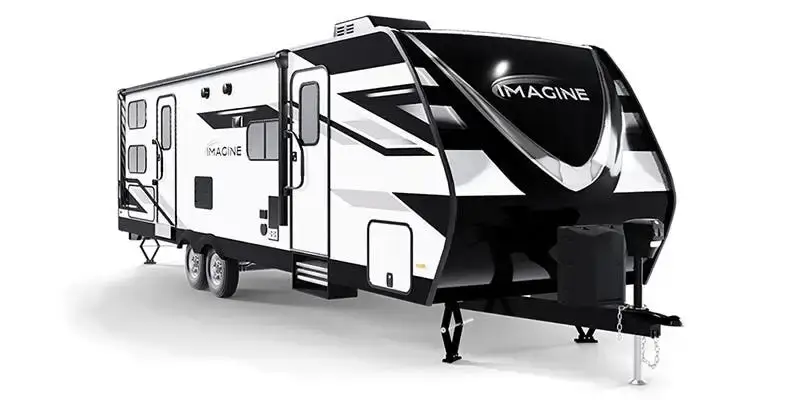
- UVW: ~3,600–10,400 lbs
- Length: ~17–39 ft
- Sleeps: 2–10
Grand Design is a brand with a supreme reputation and a loyal following. In fact, I have a personal anecdote that demonstrates just how top-notch their service is.
My friends and I look forward to the annual Oregon Rally. We always connect with old friends and make new ones alike while attending workshops and planning new adventures. But I’ll tell you what surprised me most—
One year, Grand Design reps came to personally tell owners about an ongoing recall, and they even made free on-site repairs. Now that’s what I’d call first-rate customer service, and it’s exactly that level of care that also earned Grand Design the #1 spot on our review of the best RV brands and manufacturers.
But Grand Design’s numero uno appeal goes well beyond customer service. The company has built a reputation for producing travel trailers that strike an excellent balance between quality, comfort, and practicality. Owners of Grand Design trailers frequently praise the brand’s thoughtful floorplans, generous storage, and attention to everyday livability. These are RV trailers built with long-term vehicle living in mind, designed to be comfortable after a week, a month, or even an entire season on the road.
Of course, all that quality comes at a higher price. Grand Design trailers typically cost more than many entry-level competitors, and popular models often command strong resale values that keep used prices high as well.
But for many RVers, the combination of quality construction, elite customer support, and glowing owner satisfaction makes the extra investment worthwhile in the long arc. If you’re not sure where to start, the flagship Imagine lineup is the safest bet and remains Grand Design’s most popular family of trailer rigs. But other models like the Reflection Series get even more deluxe, offering a more residential feel to ensure even the scrappiest of adventures feel… grand.
Best for Going Off-Grid
2. Outdoors RV
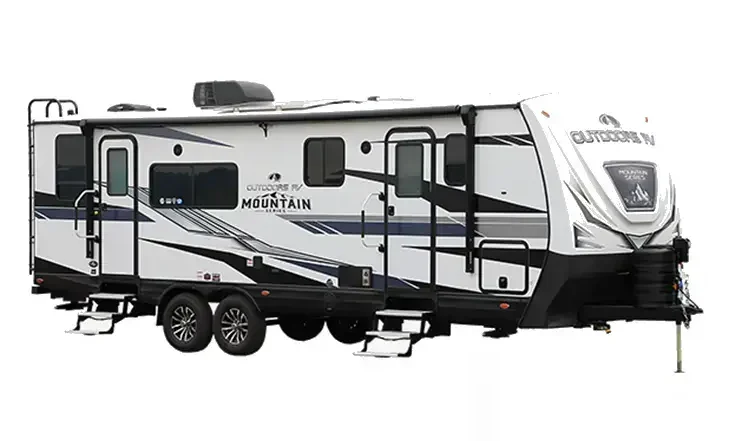
- UVW: ~5,400–8,400 lbs
- Length: ~23–35 ft
- Sleeps: 2–10
If you love wild adventures and finding the little middle-of-nowhere hidden gems, then Outdoors RV might be your jam! This brand loves pumping their trailers up with rugged construction and serious off-road capabilities.
Across Outdoors RV’s trailer models, powerful shock-absorbing suspensions are common, as are quality materials and reinforced builds. Exterior walls are made solid and often with fiberglass skins. Plus there’s a diverse range of models available too, from compact, little trailers and toy haulers up to larger, family-sized floor plans.
Big, boondocking-friendly water tanks are another standout feature of Outdoors RV. Onboard water systems and other amenities tend to be more off-grid friendly, allowing for more comfortable stays when camping and boondocking out in the sticks. Even better, amongst the more luxe series, you’ll find thermal pane windows and underbelly heating keep you toasty on frigid mornings.
Now, it’s important to note that Outdoors RVs won’t be the right brand for everyone — you really need to be enjoying that off-grid power. Otherwise, you’ll generally be lugging much heavier campers with a bigger truck and spending more on fuel as a result, all without realizing the full camping potential.
But for off-grid and offbeat aficionados, Outdoors RV is the top pick. If you’re looking for a versatile all-rounder, you can start by scoping out the Timber Ridge lineup, while something like the Back Country Series showcases Outdoors RV at its most off-grid and boondocking-capable. But whichever way you roll…
This brand is the adventurous choice for real big country adventures.
Most Iconic Trailers
3. Airstream

- UVW: ~2,700–8,500 lbs
- Length: ~16–33 ft
- Sleeps: 2–8
Founded in 1931, Airstream has spent nearly a century building some of the most recognizable travel trailers ever made. These travel trailers are absolutely iconic in the RVing scene! This brand’s aerodynamic, high-quality design has stood the test of time, enshrining Airstream as one of the most recognizable names in the RV industry.
The construction of these classics is one aspect where the signature Airstream design really shines through. While most travel trailers blend into a sea of fiberglass, Airstream’s iconic aluminum trailers have been turning heads for generations. Their riveted aluminum shell and aircraft-inspired construction create a distinctive look that’s instantly recognizable whether you’re at an RV rally, a campground, or cruising down the interstate.
Even better, Airstream backs its travel trailers with a 2-year transferable limited warranty and a 5-year structural warranty covering key components. This includes the chassis, framing, roof, and signature aluminum shell structure. (Plus, you can always check out some comprehensive extended RV warranty services for even MORE protection.)
Most people probably picture the Classic Series with its iconic silver bullet design when they think of an Airstream, which is admittedly a fantastic luxury choice if you’re ready to invest. But the brand also offers a whole diverse range, from the compact Basecamp or lightweight Bambi models for smaller tow vehicles up to the family-friendly Flying Cloud and off-grid-focused Trade Wind.
But I hope your travel trailer budget is high, because all that excellence comes at a cost! That (admittedly awesome) aluminum construction drives a higher price than typical fiberglass shells, plus it tends to be more susceptible to dents and dings. These are entirely cosmetic, but it’s still worth considering.
But… like… look at the thing! If you’re after an iconic travel trailer, these silver bullets are about as iconic as it gets. And with nearly 100 years of history behind the brand, you know they’ve got to be doing something right.
Most Innovative Lightweight Trailers
4. Safari Condo
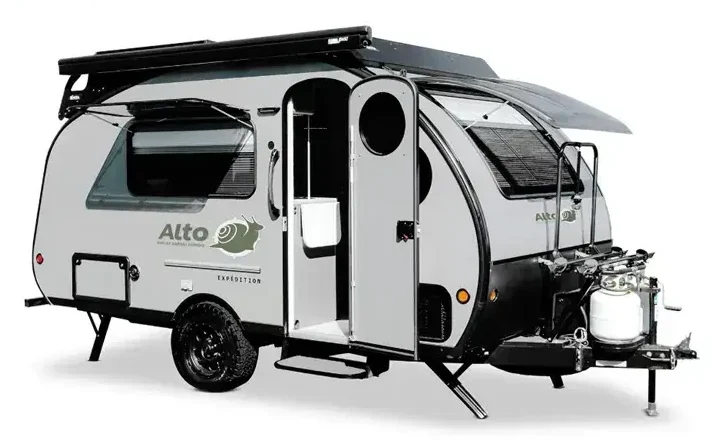
- UVW: ~1,900–2,900 lbs
- Length: ~17–24 ft
- Sleeps: 2–5
This Canadian travel trailer brand brings a lot of innovation to the RV space despite being around for about 30 years of business. In particular, they have built a steadfast reputation for lightweight and smaller travel trailers. A lot of them are even towable by SUVs, meaning you can forgo a pickup truck!
Beyond that, Safari also emphasises several standout features you often don’t see in trailers this compact:
- A focus on sustainability and utilizing recycled materials
- Big windows and smart layouts
- Retractable roofs
- Super tight weight ratings and aerodynamic designs
- And more!
Safari Condo’s Alto Series of trailer models, across the retractable roof R-series, fixed roof F-series, and the more aerodynamic A-series, all offer a new approach to the towable RV life that it’s hard to find done so well elsewhere on the market.
Of course, with so many fresh ideas often come some downsides. In Safari Condo’s case, they are an innovative but smaller manufacturer, which limits their availability and dealer network compared to mass-market RV brands, as well as drives up prices and wait times. Additionally, these more compact rigs tend to run lower on space, meaning you’ll need a few clever RV storage solutions to get all your favorite gear.
But this is a strategic pick for lightweight RVers. If you want innovation, efficiency, and minimalistic elegance (with a few premium features along the way), Safari Condo is the overlooked hidden gem way to go!
Best Four-Season Models
5. Northwood

- UVW: ~4,800–9,000 lbs
- Length: ~22–32 ft
- Sleeps: 2–10
I am biased toward the Northwood RV brand, especially since I live in one of the company’s Arctic Fox truck campers!
But then, to be fair, a lot of RVers are biased toward Northwood. They’ve established a cult-like following due to their premium quality, excellent craftsmanship, and dedication to manufacturing four-season-ready rigs, and are backed by a loyal customer base of nomads who refuse to let cold weather dictate their camping schedule.
Unlike many manufacturers that simply add extra insulation and call it a day, Northwood designs its RVs from the ground up with features that put four-season travel at the forefront. Across various Northwood RVs and travel trailers, you’ll find winter-friendly features like:
- Heated and enclosed holding tanks
- Thermal-pane window options
- High-density block foam insulation
- And robust, weatherproof construction
The company’s Arctic Fox lineup is particularly respected for its cold-weather capability, meanwhile, Nash models offer a more budget-friendly path into the Northwood family.
Yet, achieving such an all-weather level of adventure-readiness does affect the suitability of the rigs. Northwood’s campers are often heavier and pricier than those of other brands, plus have a function-first reputation with some of their interior designs and finishes feeling relatively dated. I’d say you really need to want to sink your teeth into some winter RV camping before committing to a Northwood rig.
But phew — for cold bugs, something like an Arctic Fox travel trailer is a dream. Whether you’re chasing fall colors, extending your camping season into winter, or simply want a trailer built to handle harsher conditions, Northwood’s heavy-duty approach continues to stand out in a market increasingly focused on lighter and lighter weight construction.
Best Lightweight Traditional Trailers
6. Lance
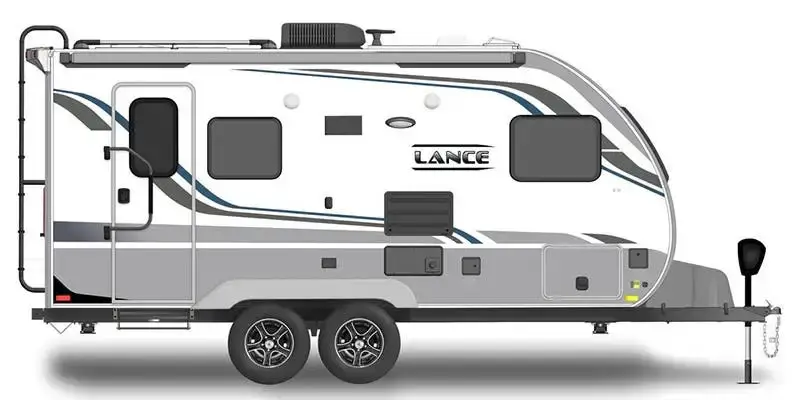
- UVW: ~2,900–6,400 lbs
- Length: ~20–31 ft
- Sleeps: 2–5
Much like Northwood, Lance has earned a strong reputation for their truck campers. (Even featuring alongside Northwood in our review of the market’s best truck camper models.) But the company soon bolstered that reputation with their performance in the lightweight RV trailer space. Lance was even my runner-up choice during my own buying process!
First up, the brand puts a lot of emphasis on utilizing top-tier materials. You’ll find aluminum frames, Azdel composite panels, laminated fiberglass exterior walls, and even premium lightweight cabinetry and finishes across a lot of Lance trailers. As a result, you get a tow-friendly and easier-to-manage rig complete with durable construction.
And speaking of tow-friendliness, that’s another of Lance’s real drawcards. Through a combination of several standout features — such as dexter torsion axles, aerodynamic profiles, and balanced, high-quality chassis — the handling, maneuverability, and overall towing experience are greatly improved compared to competitors.
For example, the Lance 1575 trailer rig clocks in at only around 3,300 lbs dry (despite a very spacious interior), and is often towable with midsize pickups or SUVs. Take it up another notch and you get the Lance 1985, weighing in at a still relatively modest 4,500 lbs dry weight but with a spacious rear bath, ample storage, and range of flexible floor plans.
Similar to Safari Condo, Lance takes a hit for price and availability. Though not nearly as niche, Lance RVs still have a more limited in dealer netweorks and without as much diversity in their product range as mass-market brands, mainly excelling for their lightweight trailers.
But for RVers who want to live the tow-life without the extra baggage it entails, Lance is a damn good pick. They’d also be one of my top picks for solo travelers and couples, able to keep your adventures lower in footprint but not lower in comfort.
Best Compact Trailer Rigs
7. Casita

- UVW: ~1,800–2,000 lbs
- Length: 15–17 ft
- Sleeps: 1–4
Lance does lightweight meets superior comfort. But what if all you wanted was a crazy compact trailer with a cult-like following? Then you’d have Casita, with a distinctive style of trailers almost as iconic as Airstream!
Now to reiterate, the focal point is on trailer compactness. That naturally means you get things lightweight, with most Casita trailers having a grand total of ~3,500 lbs GVWR and being towable by SUVs and midsize pickups. Honestly, Casita rigs generally sit at a beautiful mid-point between the top-rated pop-up campers and more spacious but nonetheless heavier travel trailers, like Lance models and everything above them.
Moreover, Casita uses a direct sales model, selling straight to customers without routing through a traditional dealer network. That means you’ll work with the manufacturer throughout the buying and customization process, never once having to engage with a dealership. There’s even the Casita Discovery Program, which pairs prospective buyers with local owners and allows shoppers to see a trailer in person, ask questions about real-world ownership, and get an authentic perspective before placing an order.
So while Casita offers a more grass-roots approach to RV camping, the trade-off for the compact footprint is a more limited living space. Storage is stricter, the wet bath is small, and families or campers who want separate bedrooms or spacious kitchens may find themselves quickly outgrowing the trailer.
Some models give you options, such as the Heritage Deluxe combines a rear double bed with bunk beds to sleep small families. But really, I’d check out the Spirit Deluxe for its versatile floorplan, wet bath, and shocking balance of comfort to flexibility for such a compact rig.
Because compact is Casita’s game! Easy storage, easy towing, high resale, loyal community, serious durability, and a complete absence of RV dealers really locks in the “simplicity is bliss” ethos. Good things definitely come in small packages. 😉
How to Choose the Right Travel Trailer Brand
Now that you’ve seen our favorite travel trailer brands, here’s the uncomfortable truth: there isn’t a universally “best” trailer, neither by make nor model.
There is only the best trailer for how YOU camp.
A retiree spending six months snowbirding through national parks has very different needs than a family squeezing in weekend trips between soccer games and school holidays. The right choice comes down to matching the trailer to your camping style, travel preferences, budget…
…and the tow vehicle lugging it all.
It All Starts With Your Tow Vehicle
Before falling in love with any floorplan, start by looking at what you’re towing with.
Manufacturers love advertising dry weights — i.e., the RV’s unloaded weight at the time of sale — because they look impressive on paper. The problem is that no RV ever travels at its dry weight. Water, propane, batteries, camping gear, food, personal belongings, and one to three gremlins (plus furry fwends) all add up quickly.

If you’re towing with an SUV or half-ton truck, lightweight-focused brands like Lance, Casita, and Safari Condo will generally offer the most suitable rigs. Casita, in particular, is often even Jeep-friendly (though I’d really advise cross-referencing the tow ratings and capacities of your Wrangler against your compact dream-rig before committing).
Conversely, heavier-duty pickups like one-ton trucks are much better equipped for luxurious, off-grid, and all-weather brands. Manufacturers like Grand Design, Northwood, or Outdoors RV are all packing a lot more oomph into their full-size rigs, so your tow will need a little more juice in the caboose too.
So when buying a travel trailer, the best place to start is with your towing capabilities. An overloaded truck might not even make it to the next county, so the selection process really just flows downstream from there.
How to Quickly Calculate Towing Suitability
Before you fall in love with a trailer, ask yourself one simple question: will its estimated loaded weight stay below about 80% of my vehicle’s maximum tow rating?

To get a rough estimate, take the trailer’s UVW (Unloaded Vehicle Weight or “dry weight”) and add 800–1,200 pounds for water, propane, batteries, food, camping gear, and everything else you’ll pack. That’s a good rule of thumb for estimating the final loaded weight.
Many experienced RVers recommend keeping that number at or below 80% of your vehicle’s maximum tow rating. While it’s not a hard rule, it provides a useful margin for safer and more comfortable towing, especially on steep grades, in strong winds, or during emergency maneuvers.
Of course, this is only a quick reality check. Your vehicle’s payload, hitch weight, passengers, and cargo ultimately all play an important role in determining what you can safely tow. For a more accurate assessment, you’ll have to really crunch some numbers… or just use this handy online tow calculator to compare your specific vehicle and trailer combination!
Consider How You Like to Travel and Camp in an RV
Anyone can shop for the trailer they imagine themselves using in fantasy RV land. But savvy shoppers hunt for the trailer they’ll actually use.
If most of your trips involve nice RV parks and solid hookups you won’t have much need for a boondocking Batmobile. Instead, you can splash some cash for added comfort, bigger floorplans, and more interior features. Brands like Grand Design and Airstream excel in this category.
However, if your idea of a good weekend involves disappearing into a forest with no other humans and only the bugs to bug you, then you do need a boondocking Batmobile! That’s when brands like Outdoors RV or Northwood sneak in with their rugged four-season constructions and off-grid capabilities.
Meanwhile, travelers who value simplicity, fuel economy, and easy towing may find themselves gravitating toward compact options like Casita or Safari Condo. You see the pattern?
First, you figure out how you like to dance. Then you find the shoes that fit.
Remember That Four-Season Capability Isn’t Free
Many RV manufacturers advertise “extended season” or “all-season” camping, even when the rig is less-than-equipped for gnarly climes. In reality, true four-season capability requires more than just some warmer carpets. You need things like:
- Additional insulation
- Enclosed underbellies
- Heated tanks
- Accessories like insulated RV winter skirting
- And more robust construction
Those upgrades make cold-weather camping far more comfortable. But they also increase your RV’s weight, add more complex systems, decrease fuel mileage, and increase associated costs.

If you’re a regular ol’ winter warrior who enjoys camping in freezing temperatures, brands like Northwood and Outdoors RV justify the extra investment. Otherwise, if most of your adventures happen during the warmer camping seasons, I’d suggest keeping the budget trim by going for a lighter and more affordable trailer.
Don’t Overlook RV Dealerships and Customer Support
Even the best-built, highest quality travel trailers will still eventually need repairs, warranty work, or replacement parts. (That’s also why, no matter how confident you are in your rig, I always recommend investing in a comprehensive roadside assistance plan.)
Before buying an RV or trailer, always check out the brand’s dealer network in your area. A fantastic trailer becomes a lot less fantastic when the nearest qualified service center is twelve hours’ drive across the badlands. That’s an issue you see crop up with more niche trailer brands like Safari Condo or Lance to a lesser degree.
This is one area where larger manufacturers and mass-market brands often have an advantage. While smaller brands may offer exceptional quality, the more limited access to dealers, parts, and service repairs can sometimes really hurt at the worst possible moment.
A common mistake first-time RV buyers make is to exclusively focus on sourcing new rigs. New rigs might come with that new RV smell, but they also come with higher prices, rapid depreciation, dealer fees, and even higher tax and insurance costs.
The good news is that RVs aren’t toothbrushes. They last a helluva lot longer (especially when taken care of), and you can share them too!
In many cases, a well-maintained used trailer from a premium manufacturer can provide better quality and durability than a brand-new entry-level model at a similar price point. Airstream is a fantastic example of this — brands with strong reputations often retain their value for a reason.

For US readers, if you’re looking for some great used RV marketplaces in the States, you can try these platforms:
- RV Trader
- Facebook Marketplace
- RVT
- RVUSA
- And sometimes even Craigslist
All in all, don’t be afraid to expand your search beyond the new inventory sitting on dealership lots. Sometimes a little pre-loving goes a long way. 😉
FAQs About Travel Trailers
Hey motor-homies, got any last trailing questions on the topic at hand? I bet you do!
Well allow me to give you some answers that I promise won’t trail off…
I’ll see myself out.
What brand of travel trailer lasts the longest?
While no travel trailer lasts forever, some brands do have a stronger reputation for longevity than others. This usually comes down to better construction and materials, as well as stricter quality control processes. Airstream, Northwood, Lance, and Casita are all known for producing trailers that can remain on the road for decades when properly maintained.
That said, regular maintenance procedures are the deciding factor way more than the logo on the hood. Preventing water leaks, inspecting cracks and rust spots, recoating the RV’s roof and exterior with sealants and protective products, regular servicing, replacing tires, and addressing other small issues before they evolve into major repairs — this is the stuff that extends your trailer’s lifespan much more than choosing a particular brand.
What travel trailer has the least amount of problems?
No manufacturer is immune to the odd defect, especially since many RV components come from the same third-party suppliers. However, the brands with strong quality control and consistent owner satisfaction generally have fewer reported issues across their product lineups.
If reliability is your top priority, those same brands (Lance, Casita, Northwood, and Airstream) have earned solid reputations for build quality. Even so, it’s always worth inspecting any trailer thoroughly before buying, whether it’s brand new or used.
What is the easiest camper trailer to set up?
No travel trailer is truly “instant” to set up, but some are definitely easier than others.
- Smaller travel trailers are generally the quickest and easiest to set up. Single-axle models without slide-outs require fewer steps, while features like powered tongue jacks and automatic leveling systems can make setup even simpler.
- Larger travel trailers with multiple slide-outs naturally take longer, not to mention the added weight and size make unhitching and leveling more cumbersome. Realistically, with some practice, most owners can still be fully set up in 15–30 minutes.
After a few road trips, leveling, unhitching, and connecting utilities quickly become second nature. That said, if you want something built for effortless camping, I’d nudge you toward an ultra-compact rig like a teardrop trailer instead. (Or maybe just a humble campervan.)
How to choose a travel trailer?
To recap, the best travel trailer isn’t necessarily the biggest or most expensive — it’s the one that fits you! Before buying, consider these key factors:
- Tow vehicle compatibility: Make sure your vehicle can safely tow the trailer’s expected loaded weight, not just its dry weight.
- Floor plan: Prioritize a layout that fits your group size and how you’ll actually camp, whether that’s extra sleeping space, a larger bathroom, or a dedicated workspace.
- Build quality: Look for durable construction, solid cabinetry, and a manufacturer with a strong reputation for quality control and customer support.
- Camping style: Think about where you’ll spend most of your time. Frequent off-grid campers will want larger tanks and better insulation, while campground users can spend on luxury.
- Budget: Factor in more than just the purchase price. Insurance, sales tax, maintenance, storage, hitch equipment, and campground fees all contribute to the true cost of ownership.
Taking the time to match the trailer to your RVing needs will almost always lead to a better ownership experience than simply buying the highest-rated brand. Or when in doubt, just buy an Airstream.
Nobody ever has a bad time camping like a damn icon.


This list is clearly made by a novice whose knowledge peaks at a level that’s casual at best.. either that or she relies on corruption in order to get published. The fact airstream is on any list is a joke. No slides, limited storage, low ceilings, limited option to customize plus it’s astronomically overpriced.. the only thing airstream does is ride the bandwagon gravy train and prove Humans always have and always will Be f*****g r******d when it comes to Facts, science, and keeping their emotions parallel to reality. There’s ZERO reason airstream should be on any best of list. Brinkley not being on there and airstream overly emphasized.. it’s like they got somebody to write this article who’s been to one RV show or stayed the night one weekend in the fall..
Hey Emerson,
Thanks for sharing your thoughts. I agree that Airstream is a divisive brand, and not everyone will agree with our take on their rigs. That’s what makes the RVing community so great: a diverse array of opinions, preferences, and priorities!
All that said, I’d appreciate it if the discussion is kept constructive and respectful. A little more kindness makes it a better exchange of ideas for everyone. 🙂
Brinkley is definitely an up-and-coming brand with a lot of promise – thanks for mentioning it. If you’ve had firsthand experience with them, please let us know; we’d love to hear what makes them such a win for you.
Thanks again for your input!